
Overview
A walk through HopOn India app around Dalhousie Square or BBD Bag as they call it today. It is the central district of Kolkata and was once the administrative and commercial hub of British India.
The most special features of this experience are : 1. The App opens up new places and new stories for you in the same old cities 2. Each walk is crafted like a masterpiece to offer an immersive experience to the traveller with the correct mix of history, culture, myth, food , through professional narration, with background scores of music, qawalli or sound affects, here and there 3. There is no need for you to depend on a guide - the traveller can take the walk anytime as per will, at his/ her own pace 4. The content is developed by domain experts and curated with utmost care, leaving no room for dependence on the guide's knowhow 5.You pay once for three months and need not pay the guide repeatedly.
- Recommended by 98% of travelers
- Badge of Excellence
- Mobile ticket
What's included
The tour can be accessed multiple times up to a certain validity period
Audio Guided Walking Tour Through HopOn India App
Headphones/Earphones (We request please carry your Headphones/Earphones)
Hand Sanitizer (We suggest please carry Hand sanitizer)
Meeting and pickup
Travelers meet at the meeting point.
Meeting point
Curzon Park Gate near Rash Behari Bose Statue on Marx Engeles Beethi Road
End point
The walk will end at the Currency Building on B.B.D. Bagh E
What to expect
-
15 min
The entrance of the Curzon Park with the Governor’s House to your back. It commands a good view of both the stately Raj
Bhavan and the splendid Esplanade Mansion.
It is difficult to believe that the rundown park used
to be covered with flower beds till the 1940’s.
Earlier, it was all water. Dharamtalla Tank, the water
body that used to exist here, was on its north-east
corner and it covered one-fourth of what is now the park -
15 min
It belongs to the Life Insurance Corporation of India
or LIC now, but it was constructed in 1910 by the
Jewish tycoon, David Ezra. A giant neon sign LIC
logo of the folded hands protecting a flame is
installed on the terrace. The LIC is one of India’s
richest landlords. According to a large signboard on
the building’s ground floor wall, its address is 14/16
Government Place (East). The ground floor is
occupied by the Eastern Railways. It has three
blocks with eight flats in each. The flats command a
great view of the Maidan. All the 999 windows
catch the south breeze. South facing flats are at a
premium in Kolkata. -
Raj Bhavan
5 min
Raj Bhavan is the official residence of the Governor of West Bengal, located in the capital city Kolkata.. The 27 acres enclosed
by an ornamental wall are screened by tall trees and
bamboo groves. But in the 19th century up to 1870,
no trees were in sight. Its vastness can be guessed
from the remark of one of its residents, Lady
Dufferin. When asked where meals were cooked in
Government House, she remarked: “Somewhere in
Calcutta”. It was the first palace of the “City of
Palaces” as Calcutta was known then.
Several buildings had to be demolished before there
was adequate space for the construction of Raj
Bhavan or as the British called it, Government
House. -
5 min
The Great Eastern Hotel started operating from these
premises circa 1841, when it was known as
Auckland Hotel. The name of the hotel has changed
several times. Spence’s Hotel owned by John
Spence that overlooked the Raj Bhavan’s north
entrance was built before 1830. It is a newspaper
office now. In the beginning, an Englishman named
David Wilson, who owned a confectionery shop in
what is now Bentinck Street, started Auckland Hotel
with 100 rooms at its current address and named it
after Lord Auckland, then governor general. But it
was better known as Wilson’s Hotel and it was run
by a partnership firm named D. Wilson and
Company. In 1865, the hotel was floated as a
company dubbed the Great Eastern Hotel Wine and
General Purveying Company. An eminent Indian,
the writer Tek Chand Thakur, whose real name was
Peary Chand Mitter, was inducted into its board of
directors and W.C. Bonerjee, the first Indian
president of the Indian National Congress, better
known as the Congress party today, became its
shareholder. -
5 min
Till the advent of wristwatches, C&K remained the most coveted name in master-crafted timepieces in British India. Founded by Robert Thomas Cooke and Charles Kelvey in Calcutta (now Kolkata), in 1858, C&K was frequented and desired by many in British India. Their status as watchmakers was a puller.
-
15 min
It originally
belonged to the Standard Life Assurance Company
at 32 and 32A BBD Bag.
After decades of neglect the 118-year-old building
was saved from disaster when repairs began in early
2014. The exposed brick building was painted a
dark shade of red with touches of cream.
The building was designed under the supervision of
Frederick William Stevens, consulting architect to
the insurance company, who had also designed the
Victoria Terminus railway station in Mumbai, which
has been renamed Chhatrapati Shivaji Maharaj
Terminus.
The construction of this building began in 1894 and
it was completed in 1896. Stevens, who died in
Mumbai of malaria, was a high priest of the Indian
Gothic style, but there is no trace of that in Standard
Building. Instead it flaunts some of the most
beautiful relief sculpture anywhere.
Standing at the corner of Red Cross Place and facing
Raj Bhavan, Standard Building is noticeable because
of the cupola or dome on the terrace and the weather
vane topping it. As its two addresses suggest, the
three-storeyed building has two wings joined by two
bridges across a small lane called the Vansittart
Row. -
15 min
The gigantic and beautiful architecture was constructed between 1882 to 1884 during the tenure of Lord Ripon who was the Governor General of the British India. E J Martin was the architect and the Executive Engineer C J Mills was in charge of the entire construction. The red brick structure was built on a classical quadrangular plane. It has tall windows with beautiful arches, matching sets of Corinthian pillars and railed roofs with pair of phoenixes at intervals. Originally it was meant to accommodate the offices of the finance department of the British India. Now it housed the main office of the Principal Accountant General (audit & accounts), Government of West Bengal. The decorative tablets, arching gateways and beautiful mansards at each end of the long cloisters running along quadrangles making it gracefully gorgeous.
-
15 min
The
church was built on ground gifted by Raja
Nabakrishna Deb of Shobhabazar to Warren
Hastings and the church committee. The Raja
“conveyed” the Old Powder Magazine Yard to
Hastings for sicca rupees 10,000. Hastings laid the
foundation on April 6, 1784, and it was ready in
three years. Sir John Shore commented: “A pagan
gave the ground: all characters subscribed: lotteries,
confiscations, donations received contrary to law
were employed in completing it. The Company
contributed but little: no great proof they think the
morals of their servants connected with religion.”
Sounds very similar to the drives to collect
subscriptions for Durga puja. But for St Paul’s
Cathedral on Chowringhee that was consecrated in
1874, it would have been the main place of worship
for Protestant Anglicans.
The church was designed by Lieutenant James Agg
and was modelled on St Martin-in-the-Fields of
London -
5 min
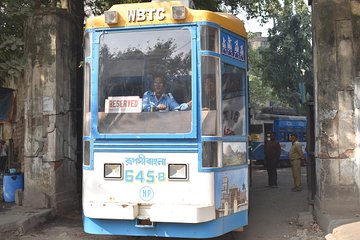
After you reached the HSBC builbing. You need to
cross the road to your left and reach the other
side of the road where you will find tram tracks.
That is the Laldighi side of Dalhousie and this is
where the tram services terminate. -
15 min
The Royal Insurance Company
Building was surely designed to give its clients the
feeling that their money was in safe hands. The
building stands cheek-and-jowl with the white Shaw
Wallace building behind it. The name of the
company is carved with a flourish on its stone face
above the entrance at the crossing of BabuTarapada
Mukherjee Sarani as the more evocative Koilaghat
Street is known today. Koilaghat as most people still
call the street is a corruption of KillaGhat or Fort
Wharf as it once ran along the southern side of the
killa or old fort. -
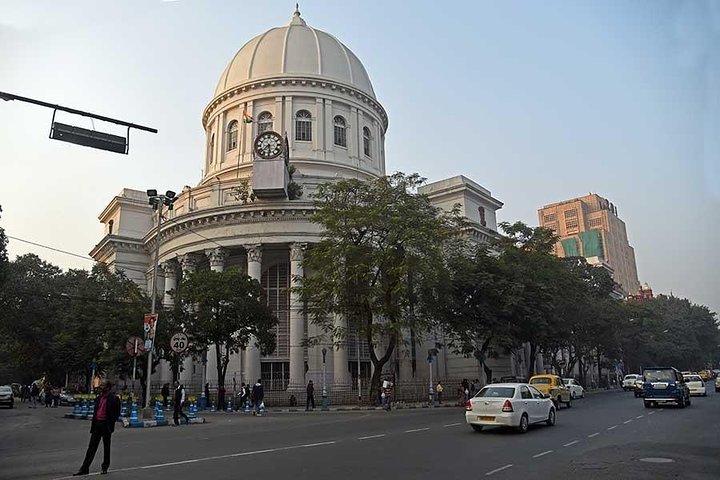
15 min
Walter B. Granville, architect to the Government of
India, who had designed the Indian Museum on
Chowringhee, St James’ Church and the Calcutta
High Court building, had also planned the grand
GPO building. The two-storeyed structure is fronted
by rows of Corinthian columns that form graceful
arcs facing BBD Bag and Koilaghat Streetor
BabuTarapada Mukherjee Sarani. It is difficult to get
used to the new name. A grand flight of stairs on
both sides leads to the high central hall.
When the GPO was being constructed, the
foundations of the Old Fort had survived at the
Koilaghat Street corner. The masonry was rock hard.
It had to be blasted. -
15 min
Road, the
red, two-storied building of the Calcutta
Collectorate constructed in 1892. After the East
India Company took charge of the three villages,
Sutanuti, Kolkata and Gobindapur, that formed the
nucleus of Calcutta in 1700, Ralph Sheldon was
appointed the first collector or zamindar of the East
India Company, who was given arbitrary powers. He
was also in charge of the police force. Among his
duties were collection of taxes, construction of roads
and keeping drains clean. Nandaram, Jagat Das,
Ram Bhadra and GobindaramMitter, who had built
the Chitpur Black pagoda remnants of which still
survive, succeeded each other as his assistants.
John Zephaniah Holwell, a Black Hole survivor after
whom the monument was named, was a zamindar
and he sacked both Nandaram and Gobindaram for
heavy frauds. Gobindaram himself wielded much
power, and he won back his position as he paid back
the sum he had embezzled. Who says there was no
corruption during the Raj? Perhaps it is difficult to
keep track of the scale of corruption today, but let us
not pretend it never existed earlier. -
15 min
The Writers’ Building that is
formally known as Mahakaran and is popularly
dubbed Lalbari or red house because of its colour. The Writers’ Building was not always red, and all
those grand neo-classical features were added on
over the years from late 18th century, when it was
constructed. It was not the seat of power either in the
beginning.
It is now being “restored” by the public works
department. -
15 min
The church’s foundation was laid by the Governor-
General, Marquis of Wellesley, in 1815 at the
initiative of Rev James Bryce. It was constructed by
Burn Currie & Co, and thanks to its high plinth,
rising damp was never a problem. It was the first
church in the city to be air-conditioned in the 1950s,
and this saved it from pollution. Air pollution is
deadly here.
The portico facing Laldighi has a triangular
pediment, and the one at the rear meant for carriages
in the past is used to park cars. It is shaded
by wooden jalis. Even in the 1950s the Scots used to
come here for Scottish country dances but by the
1960s they were all gone.
On the other side of the church is the handsome
Tobacco House once owned by the family of B.N.
Elias, a Jewish industrialist. -
15 min
The Currency Building is a rare example of the
Italian style of architecture in Calcutta. It is a
massive and handsome corner building that was
once floored up to the third storey with Italian
marble. It has a symmetrical facade, nine bays wide,
and a central portico spanning three bays.
The portico ornamented with florid cast iron pillars
and rails emphasises its grandeur. One enters it
through a giant wrought iron gate of ornate design.
The gate was made by Harris & Gibbs of Bristol,
England. Its name is emblazoned on it. Constructed
in 1868, it originally housed the Agra and
Masterman’s Bank.
Cancellation Policy
All sales are final. No refund is available for cancellations.
Times are local to the experience (Asia/Kolkata).
Additional Information
- Suitable for all physical fitness levels
- Mobile or paper ticket accepted
- Up to 15 travelers per booking
FAQs about Audio Guided Tour Through Dalhousie or BBD Bagh Area, Kolkata
Can I cancel Audio Guided Tour Through Dalhousie or BBD Bagh Area, Kolkata for free?
No. All sales are final. No refund is available for cancellations.
How long does it take?
It takes about 2 hours 10 min.
Where does it start?
Curzon Park Gate near Rash Behari Bose Statue on Marx Engeles Beethi Road
What's included?
- The tour can be accessed multiple times up to a certain validity period
- Audio Guided Walking Tour Through HopOn India App
What's not included?
- Headphones/Earphones (We request please carry your Headphones/Earphones)
- Hand Sanitizer (We suggest please carry Hand sanitizer)
Which languages is it offered in?
It is offered in English.
What fitness level is needed?
It is suitable for all physical fitness levels.
Operated by HopOn India